2026

Key point: Last week, Maine’s consumer data privacy bill stalled in the House, while Kentucky’s legislature passed a bill to amend the commonwealth’s consumer data privacy law.

Below is the 12th update on the status of proposed state privacy legislation in 2026. This post covers updates on proposed bills dealing with consumer data privacy, children’s privacy, biometric privacy, data brokers, and consumer health data privacy. As always, the contents provided below are time-sensitive and subject to change.

Key point: Tennessee’s new law prohibits parties that develop or deploy AI systems from advertising or representing to the public that the AI systems can act as a qualified mental health professional. 

On April 1, 2026, Tennessee Governor Bill Lee signed SB 1580 into law, and it will go into effect on July 1, 2026. The new law is short — less than one page — but has potentially significant consequences given that it includes a private right of action.

In the following post, we provide an overview of the new law.

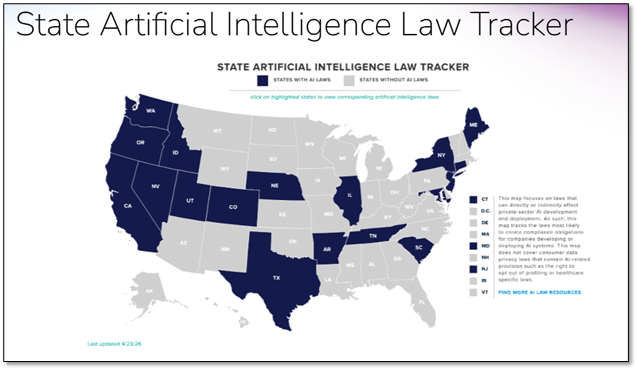
Key point: Last week, four bills were signed into law in three states, two state legislatures passed chatbot bills, and eight bills crossed chambers.

Below is the 11th update on the status of proposed state AI legislation in 2026. These posts track state AI bills that can directly or indirectly affect private-sector AI developers and deployers. These posts do not track AI bills that focus on government use of AI; insurance; workgroups; education; legal settings; name, image, and likeness; deepfakes; CSAM and sexual material; and election interference. As always, the contents provided below are time-sensitive and subject to change.
Key point: Last week, Maine’s consumer data privacy bill passed the state’s House for a second time; consumer data privacy amendment bills advanced in Kentucky, New Hampshire, and Maryland; and bills crossed chambers in New Jersey (biometric) and Vermont (data broker).

Below is the 11th update on the status of proposed state privacy legislation in 2026. This post covers updates on proposed bills dealing with consumer data privacy, children’s privacy, biometric privacy, data brokers, and consumer health data privacy. As always, the contents provided below are time-sensitive and subject to change.

In Part 1 of this series, we outlined the basics of the California Consumer Privacy Act’s (CCPA) new cybersecurity audit requirement: who is covered, when audits are required, and the key obligations to keep in mind. In Part 2, we explored the mechanics and explained what the California Privacy Protection Agency (CalPrivacy) expects the cybersecurity audit to look like in practice, including what must be evaluated, who may conduct the audit, how thorough it must be, and what goes into the audit report.

Key point: Oklahoma becomes the 20th state to enact a broad consumer data privacy law.

On March 20, 2026, Oklahoma Governor Kevin Stitt signed SB 546 into law. In doing so, Oklahoma becomes the 20th state to enact a broadly applicable consumer data privacy law.

Passage of a consumer data privacy law in Oklahoma has been a multiyear process. The Oklahoma House first passed a consumer data privacy bill authored by then-Representative Collin Walke in 2021, but the bill stalled in the Senate. The House again passed a bill in 2022, and it again stalled in the Senate.

The new law is a more business-friendly blend of the 2022 version of Virginia’s consumer data privacy law and the Texas consumer data privacy law. Ultimately, entities subject to other state privacy laws will not have any new compliance obligations. In the below article, we provide an overview of the new law.

Key point: Last week, Oklahoma became the 20th state to enact a broad consumer data privacy law, while Utah’s governor signed two bills into law, and bills advanced out of committees in Connecticut, Kansas, Maryland, New Jersey, and Vermont.

Below is the 10th update on the status of proposed state privacy legislation in 2026. This post covers updates on proposed bills dealing with consumer data privacy, children’s privacy, biometric privacy, data brokers, and consumer health data privacy. As always, the contents provided below are time-sensitive and subject to change.

Key point: Last week, the draft bill to repeal and replace the Colorado AI Act was publicly released, Tennessee’s legislature passed health care-related AI companion bills, bills crossed chambers in six states, and bills advanced out of committees in six states.

Below is the 10th update on the status of proposed state AI legislation in 2026. These posts track state AI bills that can directly or indirectly affect private-sector AI developers and deployers. These posts do not track AI bills that focus on government use of AI; insurance; workgroups; education; legal settings; name, image, and likeness; deepfakes; CSAM and sexual material; and election interference. As always, the contents provided below are time-sensitive and subject to change.
This article was originally published on The Legal Intelligencer and is republished here with permission as it originally appeared on March 12, 2026.

In this third and final article in a three-part series on the FirstEnergy decision, we turn to what happens when litigation arrives and privilege is challenged.

Over the past several years, district courts have been skeptical of privilege claims over forensic investigation materials in the cybersecurity context. FirstEnergy provides a framework for defending those materials. Every cyber investigation serves two purposes. From a legal perspective, the investigation informs litigation exposure and defense strategy. But the same investigation also identifies compromised systems, drives remediation and supports business operations. After FirstEnergy, those dual purposes do not defeat privilege, provided the investigation was initiated because of legal risk and directed by counsel. This article also examines how the lessons of FirstEnergy apply in cases involving multiple defendants that may have both a desire and need—for both business and legal purposes—to work together to understand an incident and share information.

On March 16, 2026, New York Attorney General (AG) Letitia James rallied in support of the “One Fair Price Package” — a pair of bills aimed at curbing algorithmic and surveillance pricing in New York. Together, the bills would prohibit the use of personalized algorithmic pricing based on consumer data, ban electronic shelf labels in large food and drug retailers, and create robust enforcement mechanisms and private rights of action. The announcement from New York comes shortly after New Jersey Governor Mikie Sherrill backed legislation to ban what she has called “surveillance” pricing, and after California Attorney General Rob Bonta announced an investigative sweep focused on businesses that use consumer data to individualize prices for their goods or services earlier this year.