
Key point: Just one month into 2026, state lawmakers are already considering hundreds of AI and privacy related bills.
In this post, we provide key takeaways on proposed state AI and privacy bills during the prior month. The contents provided below are time-sensitive and subject to change.
Overall Key Takeaways
1. Legislatures in Session
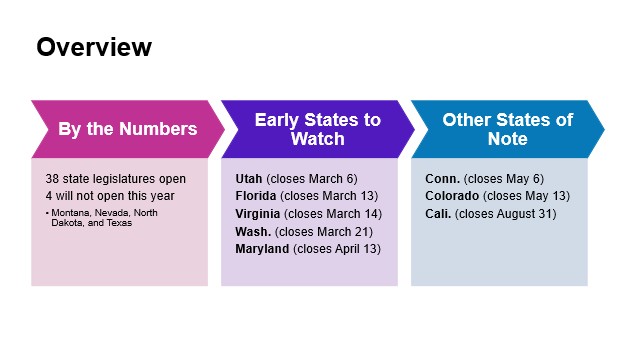
There are currently 38 legislatures in session. Ultimately, 46 legislatures will open in 2026 with Montana, Nevada, North Dakota, and Texas remaining closed. The legislatures in those four states convene every other year. The fact that Montana, Nevada, and Texas are closed should not be overlooked, as last year those states considered many privacy- and AI-related bills.
2. Early Legislatures to Watch
The length of legislative sessions varies by state. For example, California’s legislature is in session, but it will not close until the end of August. Therefore, while that is an important state to track, we tend to see developments happen later in the year, including at the May 29 deadline for bills to cross chambers.
On the other hand, some states have short legislative sessions that close quickly. This year, the states with short sessions that we are closely tracking are Utah (closing March 6), Florida (closing March 13), Virginia (closing March 14), Washington (closing March 21), and Maryland (closing April 13).
AI Bills Key Takeaways
1. Total Bills
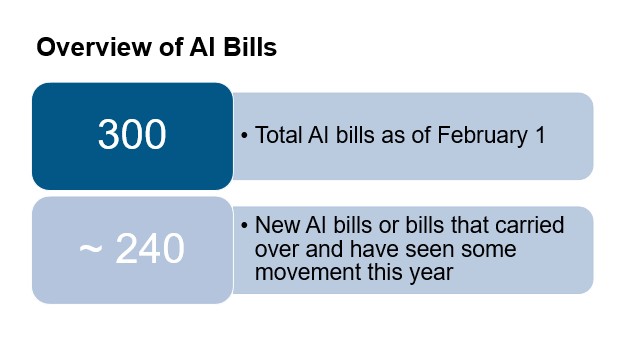
Just one month into 2026, we are already tracking 300 AI-related bills (as of February 1). Although that number is high, there are two important qualifications. First, many states had bills carry over from 2025. Entering 2026, there already was a foundation of around 130 bills that carried over. That said, 240 of the 300 bills are either newly filed or have seen some sort of movement this year.
The second qualification is that we have narrowed the scope of the bills we are tracking this year. This year, our scope is focused on state AI bills that can directly or indirectly affect private-sector AI developers and deployers. We are no longer tracking AI bills that focus on government use of AI; insurance; workgroups; education; legal settings; name, image, and likeness; deepfakes; CSAM and sexual material; and election interference. If we included those bills, the total number of bills would, of course, be higher.
All of that said, it does not appear that President Donald Trump’s executive order on Ensuring a National Policy Framework for Artificial Intelligence has had an impact on the filing of new bills. Yet, the fact that a lawmaker introduces a new bill does not mean that it is going to become law. It also is unclear what types of AI laws will be targeted by the Trump administration. As discussed in the next section, lawmakers from both parties have been filing bills on topics like chatbots and pricing, perhaps signaling that they believe those are safe areas to legislate.
2. Key Areas for Lawmakers
Of the categories we are tracking this year, we are seeing the most movement in bills regulating chatbots, pricing, and health. These bills are being filed across the country by both Republicans and Democrats.
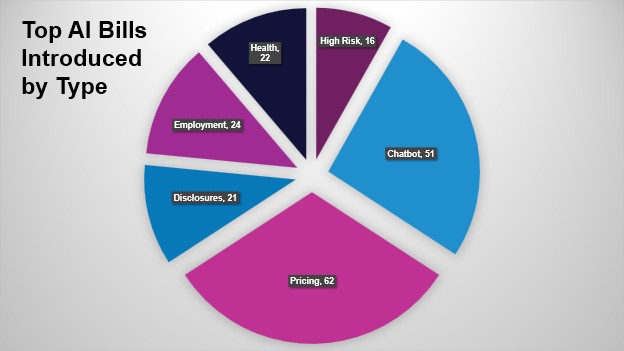
We use the term “chatbot” to cover different types of bills, but their overall similarity is that they deal with AI (really GenAI/LLMs) interacting directly with individuals. These bills include companion chatbots (where the chatbot acts as someone’s “friend” or “partner”), consumer chatbots (where the chatbot engages with individuals in a consumer setting), and health care chatbots (where the chatbot provides medical or mental health information). We are currently tracking 51 “chatbot” bills. However, that number underrepresents the total number of chatbot bills because we have placed bills that cover multiple issues, including chatbots, in other categories — e.g., Florida’s AI Bill of Rights.
Last year, several states, including California and New York, passed laws regulating chatbots. The California legislature is currently considering a bill to amend its chatbot law (SB 300). That bill unanimously passed the Senate last week.
Another topic where we are seeing many new bills introduced is pricing. Like chatbots, we are using this category to group different bills; however, in general, these bills regulate how AI is used to set consumer prices. More specifically, these bills are directed at topics, including surveillance pricing (using personal data to set prices), algorithmic pricing (setting prices based on things like time of day, availability, or personal data), rental pricing, wages, and dynamic pricing for food establishments. We are currently tracking 62 of these bills.
Health care-related AI bills are also a hot topic for state lawmakers. These bills cover topics like medical professionals using AI to diagnose patients, to prescribe medication, and to interact with patients or generate patient-related documentation. Many of these bills also deal directly with the use of AI in mental health treatment. We are currently tracking 22 of these bills.
3. Bills of Note
Although we expect to see many bills advance during the 2026 session, as of January 2026, the following bills have shown early signs of movement.
Two bills crossed chambers in New York last month. A 3411 passed the Assembly on January 28. That bill requires the owner, licensee, or operator of a GenAI system to clearly and conspicuously display a notice on the system’s user interface that the outputs of the GenAI system may be inaccurate. Meanwhile, S 8828 (RAISE Act chapter amendments) passed the Senate last week. That bill (and/or its companion bill) will pass the legislature based on the agreement with Governor Kathy Hochul when she signed last year’s RAISE Act bill.
Florida’s S 482 (AI Bill of Rights) was voted out of the Senate Commerce and Tourism Committee by a 10-0 vote on January 21. It is now with the Appropriations Committee. Among other things, the bill creates rights with respect to AI (e.g., the right to know if AI technology companies are collecting personal information), regulates chatbots and the state’s use of AI, and creates prohibitions on technology companies’ use of personal information. The bill is sponsored by Florida Governor Ron DeSantis.
On the other side of the country, Washington lawmakers have already advanced six bills out of committees — HB 2157 (high-risk AI systems), HB 2503 (training data for GenAI), SB 5984/HB 2225 (companion chatbots), HB 2481 (prohibiting surveillance-based price discrimination and surge pricing for retail goods), and HB 2144 (employment).
Meanwhile, Utah’s HB 286 (AI Transparency Amendments) passed out of committee and is on a third House floor reading, and Virginia’s SB 269 (use of AI in mental health) unanimously passed out of committee.
The early movement with bills in Florida, Washington, Utah, and Virginia should come as no surprise, as those legislatures will close in March.
Privacy Bills Key Takeaways
1. Total Bills
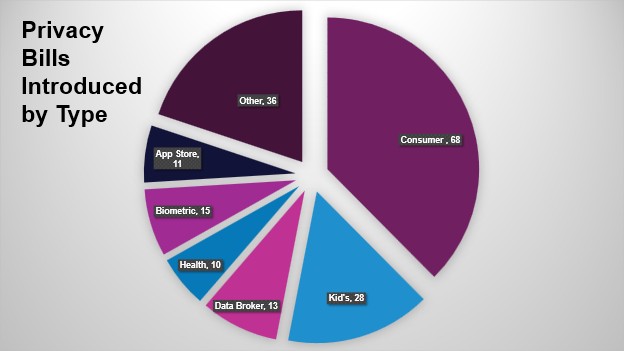
We are currently tracking 181 bills covering consumer data privacy, children’s privacy, biometric privacy, data brokers, consumer health data privacy, and other topics. The most prominent category of bills we are tracking is consumer data privacy bills (68 bills). The high number of bills (as compared to states) is caused by two factors. First, lawmakers in some states have filed multiple bills. For example, we are tracking 10 consumer data privacy bills in New York. Second, we also track bills seeking to amend existing laws. For example, we are tracking six bills filed in Virginia to amend the commonwealth’s consumer data privacy law.
2. Key Areas for Lawmakers
The regulation of children’s online activities remains a hot topic for lawmakers. Lawmakers across the country from both parties are filing bills in this area. This is not a partisan topic; it is a parent topic. However, we continue to find that there is no common approach among lawmakers, which is making interoperability difficult for companies. In addition, we are seeing lawmakers in many states file App Store bills, including bills filed in Arkansas, Arizona, Florida, Kansas, Mississippi, New Hampshire, Virginia, and Wisconsin. These bills are being filed even though a Texas federal district court recently enjoined Texas’ App Store bill as unconstitutional.
There also has been an uptick in the filing of data broker / DELETE Act bills. Lawmakers have filed bills this year in Hawaii, Nebraska, New Hampshire (bill died), New Mexico, New York, Vermont, Washington, and Washington, D.C.
Finally, while no state passed a consumer data privacy law last year, several states are in the running to pass one in 2026. Wisconsin lawmakers started moving companion data privacy bills last month. Meanwhile, carryover bills in Massachusetts, Maine, Pennsylvania, and Vermont will be worth closely tracking. In particular, bills in Massachusetts and Pennsylvania already passed one chamber.
3. Bills of Note
Although we expect to see many bills advance during the 2026 session, as of January 2026, the following bills have shown early signs of movement.
On January 20, New Jersey Governor Phil Murphy signed A 5017 prior to leaving office. The bill amends New Jersey’s consumer data privacy law to add exemptions.
In Wisconsin, AB 172 (consumer data privacy) unanimously passed out of the Assembly State Affairs Committee on January 28. It is now with the Rules Committee. Meanwhile, a public hearing was held on its companion bill, SB 166. The bills were originally filed in March/April 2025. For reference, the Wisconsin Assembly passed a consumer data privacy bill four years ago this month (AB 957), but the bill failed to advance in the Senate.
In Virgina, SB 338 was unanimously voted out of the General Laws and Technology Committee on January 28. The bill amends the commonwealth’s consumer data privacy law to prohibit a controller from selling precise geolocation data. Meanwhile, SB 232 (amends the consumer data privacy law relating to children’s privacy) was voted out of the committee by an 8-6 vote. Both bills are now on Senate floor votes.
South Carolina lawmakers passed an Age-Appropriate Design Code Act (H 3431) in January. The bill is pending action by the state’s governor. Meanwhile, Alabama’s HB 161 (App Store) passed the House and appears poised to pass the Senate.
Finally, a Hawaii Senate committee amended and advanced SB 1163. Among other things, the bill prohibits the sale of geolocation information and internet browser information without consent.